
I develop computational methods to simulate and shape light for imaging and sensing. My research focuses on Computational Optics, particularly on accurate and efficient optics modeling, light shaping, and the joint design of optics and algorithms.
I am currently a Postdoctoral Researcher at the Computational Imaging & Mixed Representation Laboratory, The University of Hong Kong (HKU). I received my Ph.D. in Optical Engineering from Zhejiang University (ZJU) in 2023, where I worked at the X Lab within the State Key Laboratory of Extreme Photonics and Instrumentation and the College of Optical Science and Engineering. Before that, I earned my B.E. in Optoelectronic Information Science and Engineering from the School of Physics and Optoelectronics, South China University of Technology (SCUT), in 2018.
News
| Sep 13, 2026 | Our works on holographic display have received the Outstanding Achievements Award at the Exhibition of Computational Imaging Achievements in the 6th International Conference on Computational Imaging (CITA 2026)!  |
|---|---|
| Aug 10, 2026 | I’m invited to give a talk at the 6th International Conference on Computational Imaging (CITA 2026) in Shenzhen! |
| May 16, 2026 | I will give a talk at 第八届“计算成像技术与应用”专题研讨会 in Shenzhen! |
Selected Publications
#Equal contribution; *Corresponding author.
- Retained accuracy with reduced precision in wave propagation modelingPhotonics Research, 2026The first paper during my postdoc!
Wave propagation simulations often face a trade-off between speed and numerical accuracy. This paper identifies the precision limits that matter and shows that lower-precision computation can still produce accurate results, helping optics models run faster and use less memory.
- Learned off-aperture encoding for wide field-of-view RGBD imagingIEEE Transactions on Pattern Analysis and Machine Intelligence, 2025
Wide-field RGB-D cameras need to recover both color and depth without losing image quality near the edges. This work places a diffractive optical element away from the aperture and jointly learns the optics and decoder, giving the system more local wavefront control and better wide-field imaging.
- In situ fully vectorial tomography and pupil function retrieval of tightly focused fieldsNature Communications, 2025The final paper of my PhD!
Tightly focused light is difficult to measure because its three-dimensional polarization structure is complex. This paper introduces an in-situ method that reconstructs the full vector field and the objective’s light-shaping pupil function from a small number of 2D measurements, enabling rapid characterization and optimization of nanoscale light.
- Accurate background reduction in adaptive optical three-dimensional stimulated emission depletion nanoscopy by dynamic phase switchingACS Photonics, 2022
Three-dimensional STED microscopy can suffer from strong background caused by optical aberrations and out-of-focus fluorescence. This work switches between carefully designed phase patterns to measure that background and subtract it, improving the signal-to-background ratio with a flexible and practical adaptive-optics method.
- Diffraction modeling between arbitrary non-parallel planes using angular spectrum rearrangementOptica, 2025My first time as a corresponding author! Top downloads in Jan 2025!
Simulating light between tilted or otherwise non-parallel planes is useful for complex optical systems, but existing methods can be slow or inaccurate. This paper rearranges the angular spectrum and uses flexible Fourier sampling to model such diffraction accurately and efficiently, including difficult orthogonal-plane cases.
- Modeling off-axis diffraction with the least-sampling angular spectrum methodOptica, 2023Top downloads in Jul and Aug 2023!
Off-axis diffraction is hard to simulate efficiently because the sampling requirements change with the propagation angle. This paper develops a least-sampling angular spectrum method that adapts those requirements, enabling accurate, fast modeling at large angles and for high-frequency optical patterns.
-
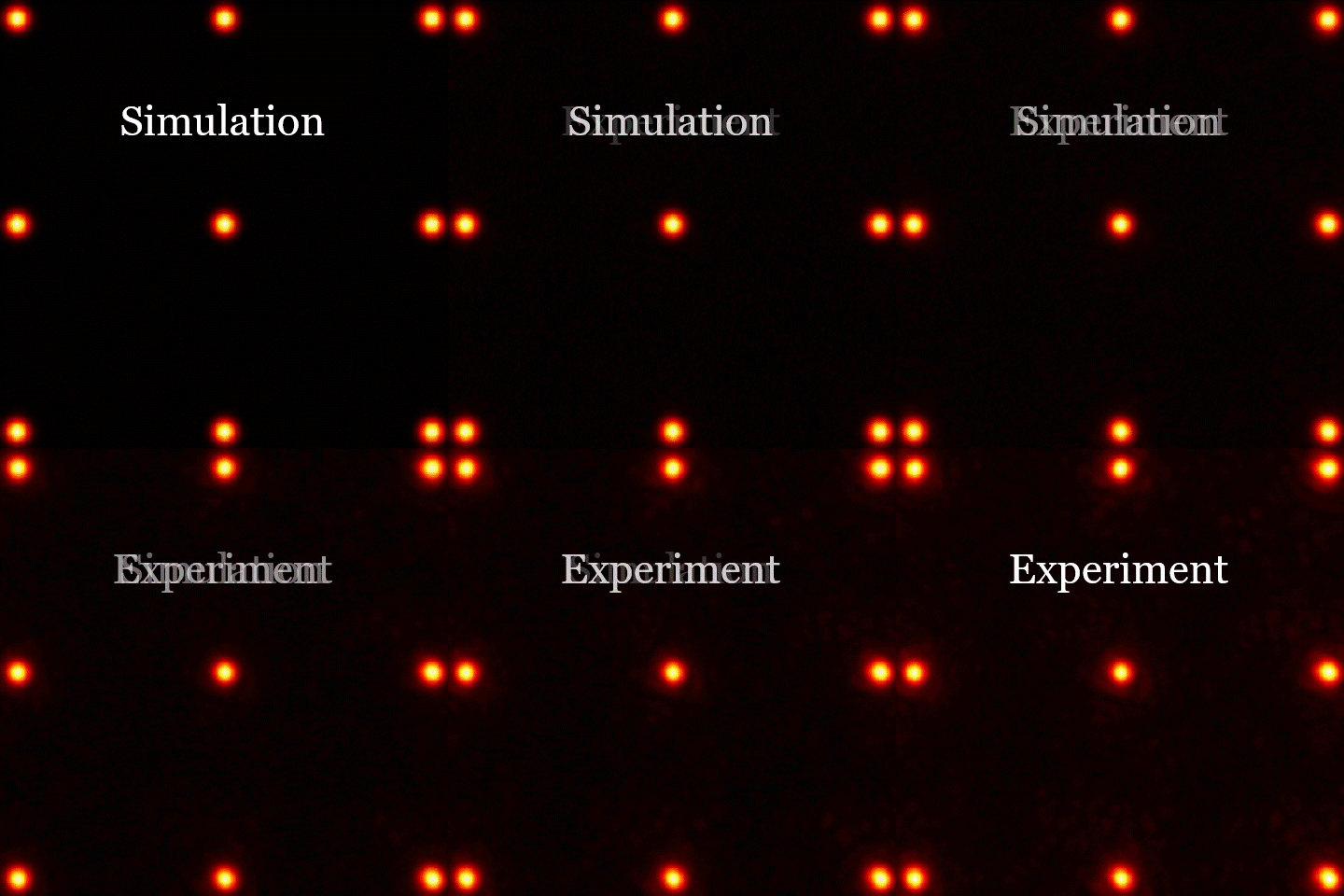 Fast generation of arbitrary optical focus arrayOptics and Lasers in Engineering, 2023
Optical focus arrays are useful for trapping, fabrication, microscopy, and displays, but conventional hologram algorithms can be slow and restrict the spot layout. This work replaces the usual Fourier calculation with a more flexible linear-algebra approach and controls each focus’s position and intensity accurately.
-
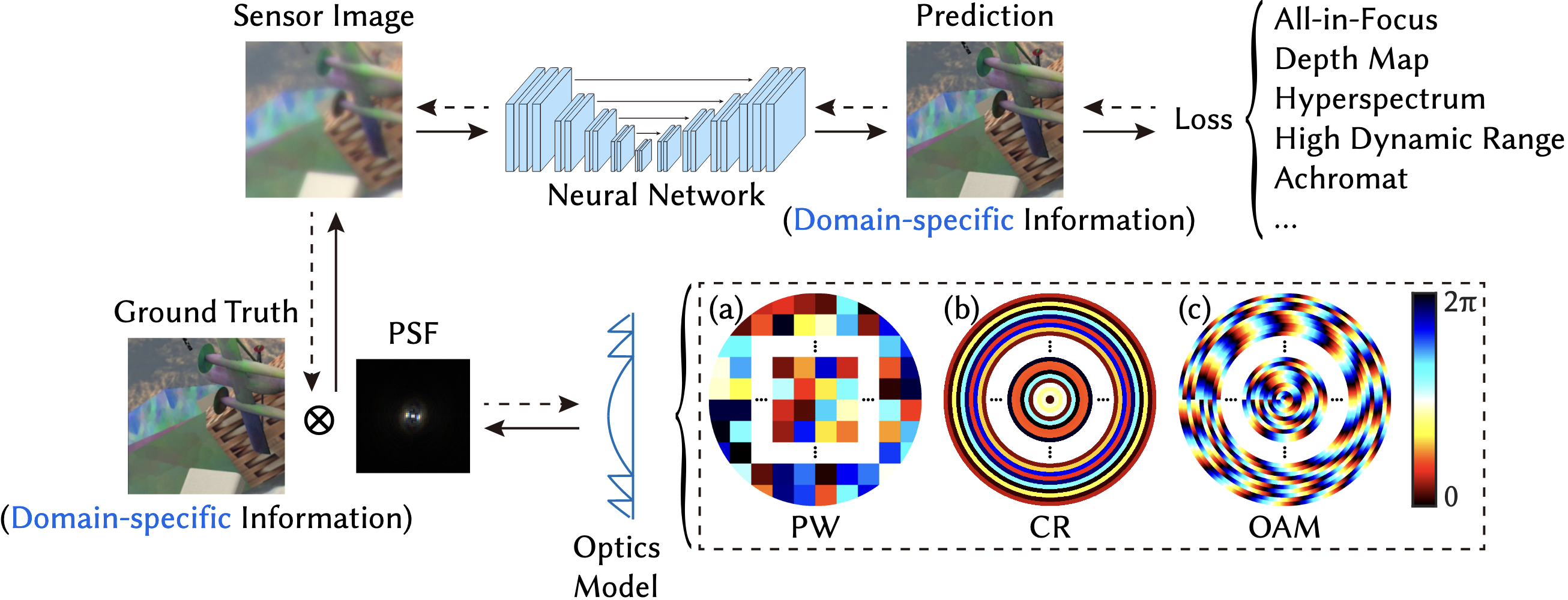 Investigating deep optics model representation in affecting resolved all-in-focus image quality and depth estimation fidelityOptics Express, 2022My first paper on computational imaging!
Deep optics jointly designs a camera and the algorithm that processes its images, but the best way to model the optics is not always clear. This study compares several optical model representations for all-in-focus imaging and depth estimation, revealing their accuracy, trade-offs, and sensitivity to fabrication errors.
-
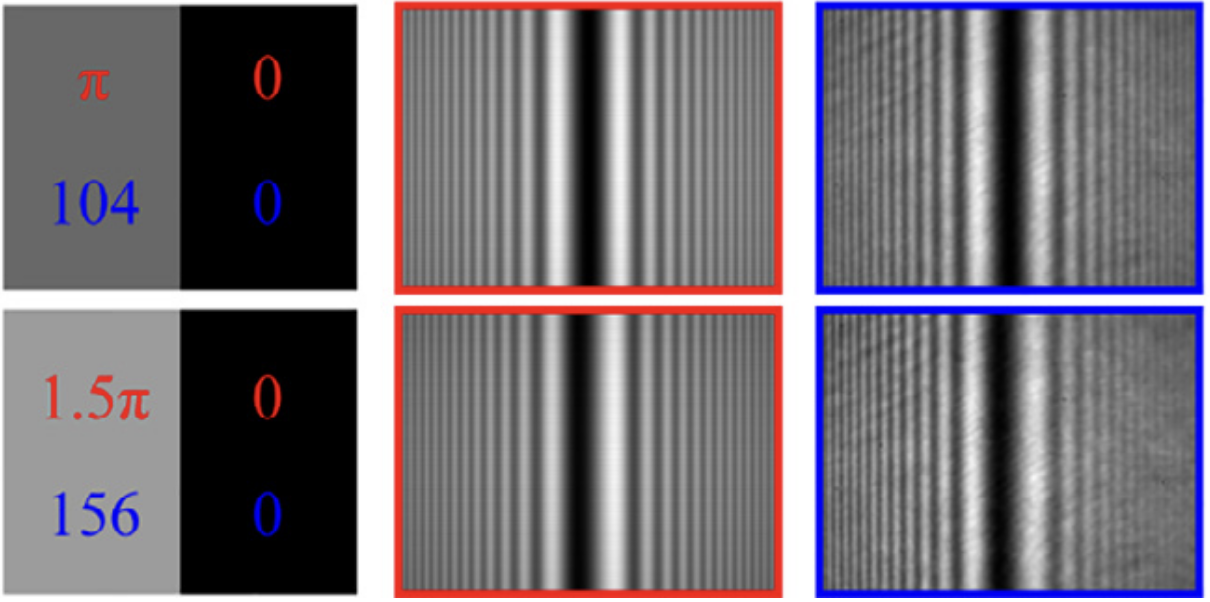 Calibration of phase-only liquid-crystal spatial light modulators by diffractogram analysisOptics and Lasers in Engineering, 2022
Phase-only spatial light modulators must be calibrated before they can shape light accurately. This paper reads the intensity pattern produced by specially designed holograms to recover both global and local phase-response lookup tables, without requiring interferometers or precise camera placement, making in-situ calibration simpler and more robust.
-
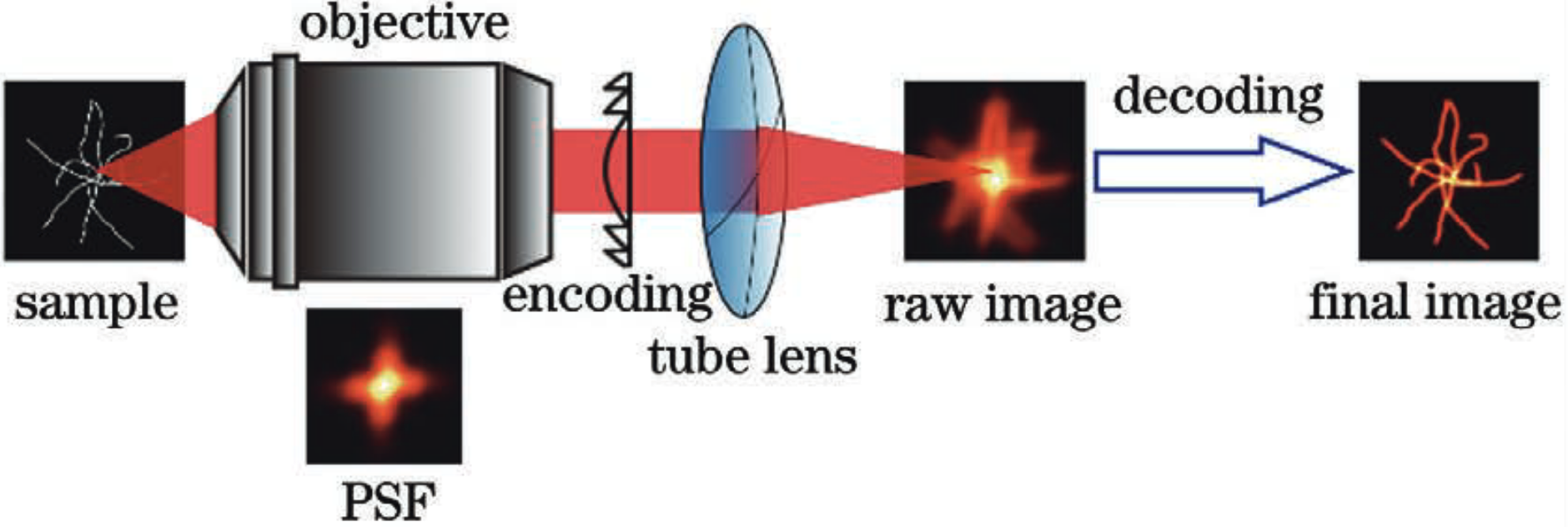 Research progress of computational microscopy imaging based on point spread function engineeringLaser & Optoelectronics Progress, 2021
A microscope’s point spread function describes how it forms an image, and deliberately shaping it can improve resolution, speed, or 3D information. This review explains the main ideas and methods of point-spread-function engineering in computational microscopy, and discusses its remaining challenges and future directions.
-
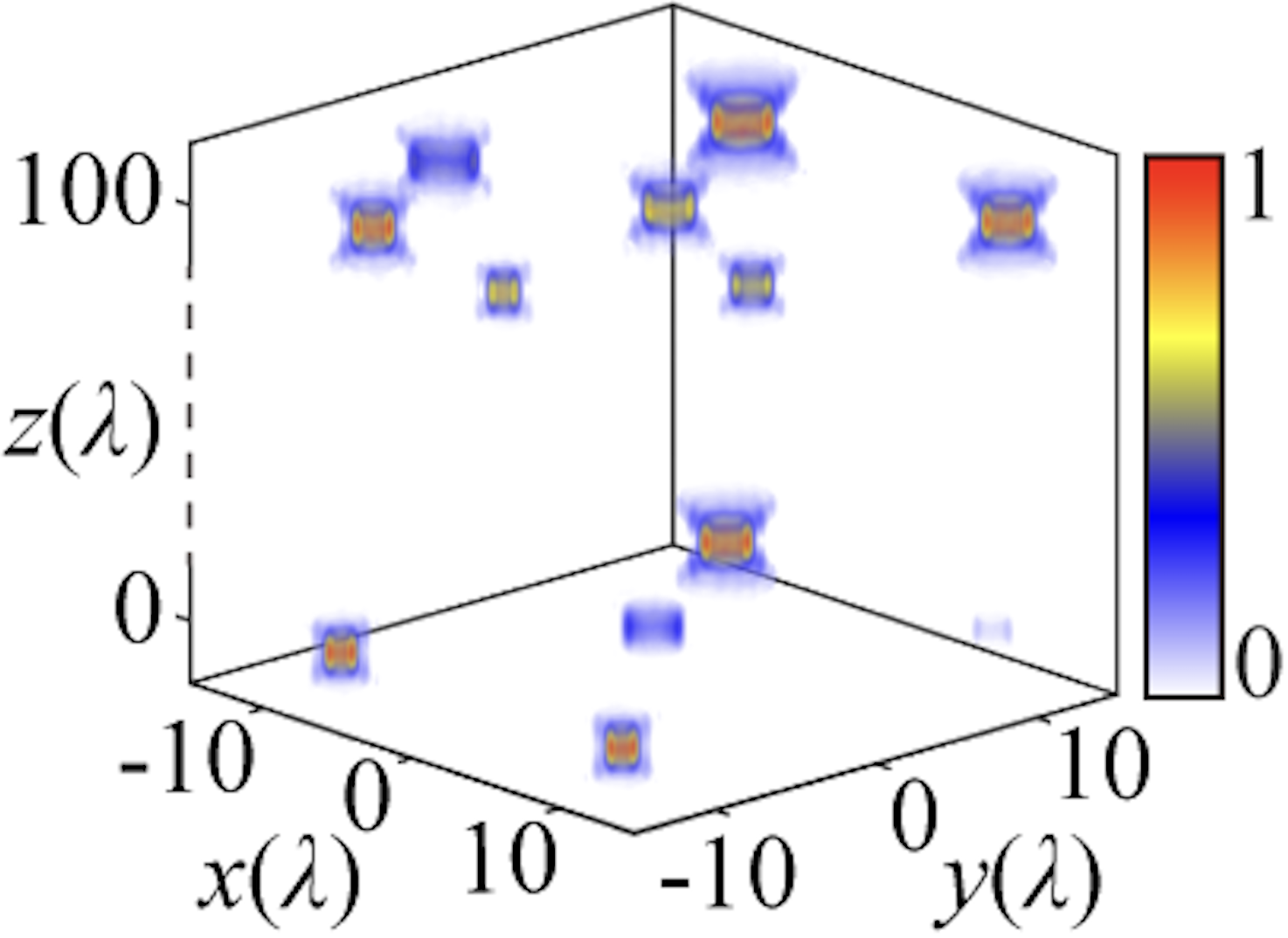 Generation of arbitrary longitudinal polarization vortices by pupil function manipulationAdvanced Photonics Research, 2021Cover story!
Longitudinal polarization vortices are structured light fields whose electric field points partly along the direction of propagation. This paper uses phase and amplitude control at the back pupil of a high-numerical-aperture objective to generate multiple vortices with chosen positions, topological charges, and tunable strengths.
-
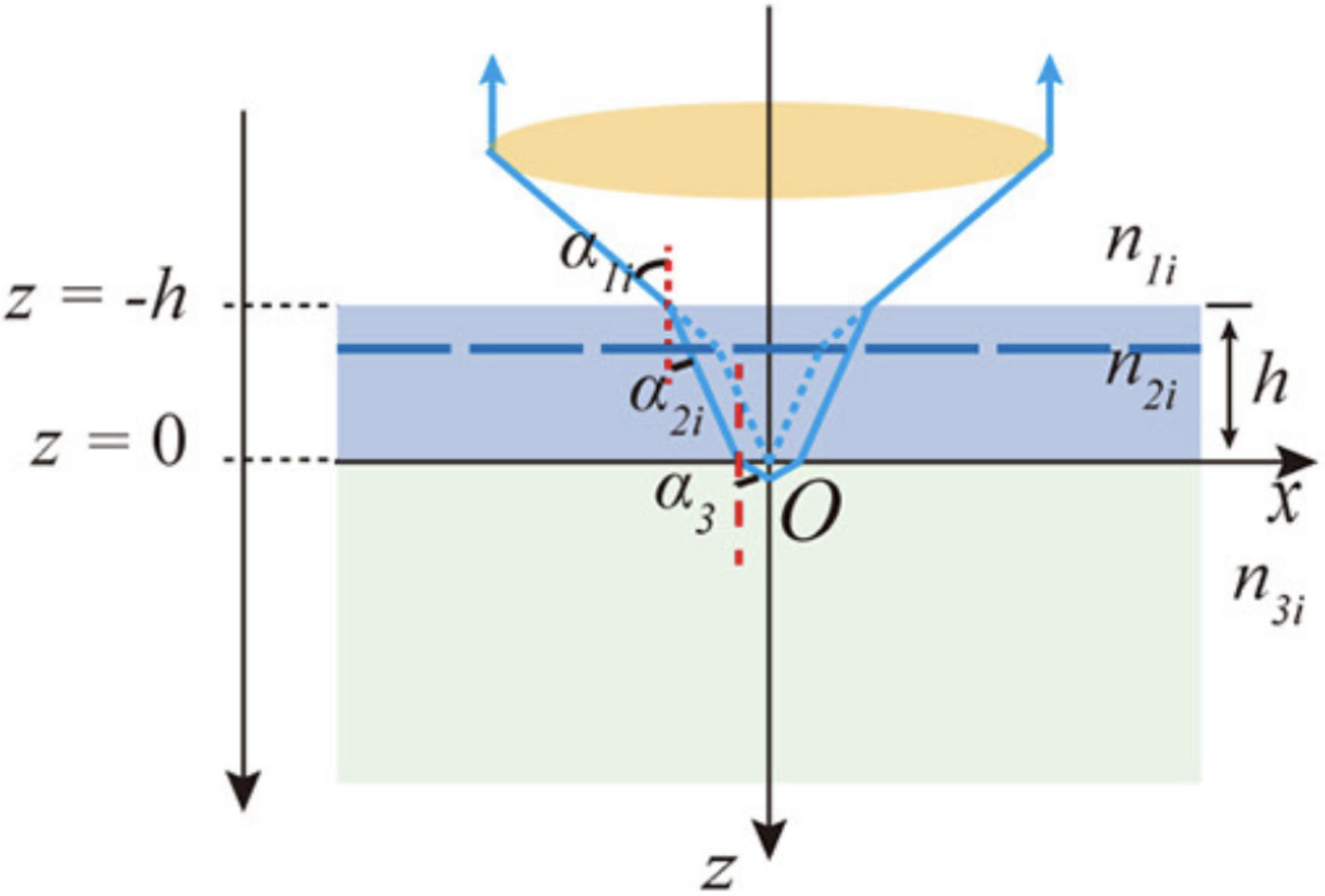 Aberrations in structured illumination microscopy: A theoretical analysisFrontiers in Physics, 2020My first scientific paper!
Optical aberrations can reduce the resolution and contrast of structured illumination microscopy. This theoretical study models aberrations in both the illumination and detection paths, and also examines beam misalignment, providing practical guidance for understanding and optimizing SIM systems.


